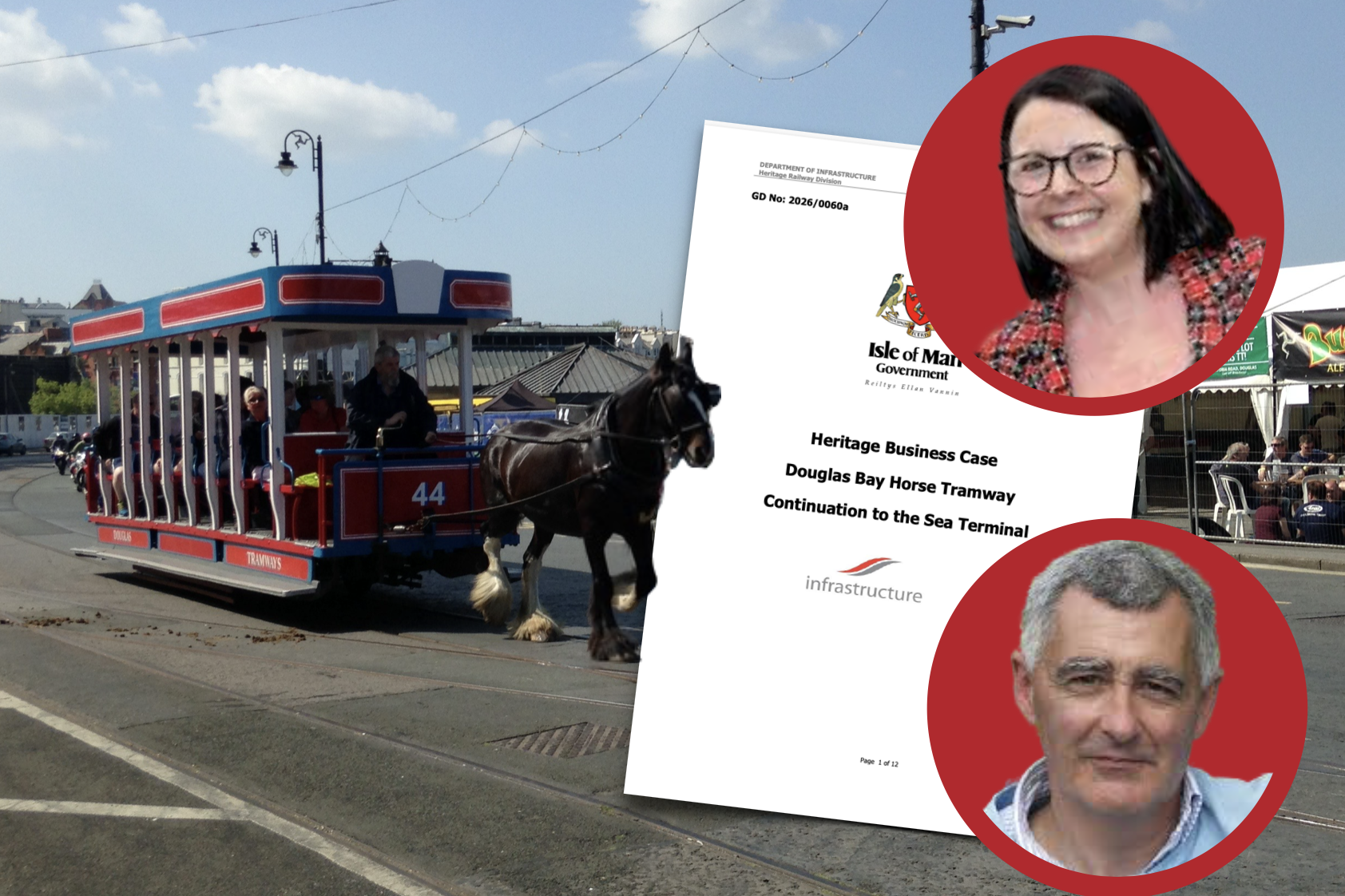
Treasury has been instructed to return to Tynwald in July with a capital funding request to complete reinstating the horse tram tracks.
During an evening session of Tynwald on June 17th, politicians reviewed the draft business case presented by the Department of Infrastructure for laying the track between the War Memorial and the Sea Terminal.
Initially, Members were asked merely to support its progress through the capital project procedures in line with financial regulations.
However Douglas South MHK Sarah Maltby introduced an amendment requesting the Treasury’s return to court next month with a specific ‘necessary capital funding request’.
Ms Maltby’s amendment was supported by all 21 members of the House of Keys present in the chamber.
Of the six MLCs voting, only Gary Clueit opposed the plan.
Earlier this month, heritage campaigner Charles Guard labelled the DoI’s business case the ‘biggest fudge’ in Manx politics, and called for an amendment to the original motion put forward by the Department of Infrastructure, a call seemingly answered by Ms Maltby.
See also report on MANX NEWS
Pending the publication of the Official HANSARD, below is an unofficial DRAFT account of the debate.
The Clerk: Gura mie eu, Eaghtyrane.
Ta mee cur roish y Whaiyl ny pabyryn enmyssit ayns ayrn jees jeh’n Chlaare Obbyr Arbyllagh Thank you, Mr. President. I lay before the Court the paper at item two of the Supplementary Order paper.
The President: Move on to item three and I call on the Honourable Member, Mr. Peters.
Mr Peters: Thank you, Mr. President, and Honourable Members. In the absence of my wounded Minister, I present the business case for continuing the Douglas Bay Horse Tramway to the Sea Terminal. I am sure that all Honourable Members will join me in wishing Mr. Crookall a speedy recovery.
Various Members: Hear, hear!
Mr Peters: I'm sure Members will agree that the horse trams on Douglas have been an important part of our island's heritage and identity for more than a century. As the business case states, it's a living museum using original Victorian and Edwardian tramcars. The business case proposes to build a single line along the remainder of the prom to the Sea Terminal, and creates a passing point at the war memorial. The tramway will be built along the corridor preserved for it as part of the Promenade Project. In conjunction with that scheme, Highways will improve the surface around the war memorial, in line with its long-standing plans to improve the full length of the walkway.
The project, excluding the highway resurfacing, is expected to cost approximately £2 million, with a 50% contingency and optimism bias discussed earlier in the sitting. A total provision for investment is £3,036,170. That is what's being sought. If the project receives funding, it will be delivered in a 40-week programme, with works undertaken in short sections and outside peak season to minimise disruption. The rail work will be undertaken with Heritage Rail's preferred framework partner, with support from other local companies.
Before the promenade works, the tramway carried up to 80,000 passengers a year. With the shortened route, this fell to 45,000. However, with reinstatement in cruise ship marketing, the business case estimates that passenger numbers could exceed 100,000 a year. I would like to take this opportunity to briefly address two matters that are routinely raised. What happened to the funding for the tramway and the Douglas Promenade reconstruction project? And have the rails already been paid for when the new prom was being designed? The question had to be considered was the tramway to be reconstructed, and if so, where on the promenade should it be built? Whilst this was being considered by the department, Douglas Corporation indicated that the horse tram operation was not sustainable.
Government through the Department of Infrastructure stepped in to save the service. This removed uncertainty about the tramway’s future and so it was included in the project. The department understood that constructing the horse tram track in the centre of the road would be disruptive to the project and costly. Its original planning application placed the tramway at the side of the road for its entire length, where it would be cheaper and less disruptive to build. However, this planning application, which I thought at the time to be eminently sensible, was rejected. Consequently, it was built in the centre of the road and this increased the length of the project and the cost.
There is a persistent view expressed that the money was taken from the tram tracks to pay for the completion of the promenade project. Senior officers in the DoI assure me that this is a misrepresentation. Parts of the highway works and a length of tramway were removed from scope to fund an acceleration of the scheme following the first Covid lockdown. In respect to the rail purchase. It is correct to say that the rails have already been bought and paid for. They're in government stock. However, as a matter of normal accounting practice, when materials such as rails are withdrawn from stock and allocated to an actual project, the cost is assigned to that project at the time of use.
This is routine practice. In short, the cost of the rails is included in the project, and this is apparently the correct way to account for what is effectively an interdepartmental transfer. There may be Members who don't want to support spending money on the horse trams. There may be Members who are supportive. I suspect that most are, but don't feel that this is the right time for such an investment. You may feel that from a tourism perspective, the investment is justified as suggested in the Systra report. Others may feel that as custodians of the heritage of the Isle of Man, we have an obligation to make this investment.
This debate and vote are an opportunity for people to express their opinion. As a purely financial investment for the Department, this project does not make any sense. The return on investment is too low. There may be a financial case for tourism, but there is no strong supporting evidence. The motion before Members seeks the support of Tynwald to progress with the scheme through the capital procedures. I should be clear that this is not a financial motion, and a vote today does not approve funding. Capital funding will need to be approved by Tynwald in the next administration.
If the motion is approved, the department will seek financial approval in the next administration through the 2027/2028 budget approval process. If the motion is not approved, then the department will stop all work on the project, but it will protect the tramway corridor. The rails are not unique to the horse tramway and can be used elsewhere on the rail network if necessary. Mr. President, I hope that this debate gives Members an opportunity to clearly state their opinion on further investment in the horse tramway. I beg to move, sir.
The President: The Honourable Member Mrs Corlett.
Mrs Corlett: Thank you, Mr. President. I beg to second.
The President: The Honourable Member, Mrs Maltby.
Mrs Maltby: Gura mie eu, Eaghtyrane. And before I begin, Honourable Members, I'd like to share a quote.
Various Members: Oh, oh. [Laughter]
Mrs Maltby: A quote from the popular American television series The Outer Limits. There is nothing wrong with your television sets. Do not attempt to adjust the picture. We are controlling transmission.
(Inaudible) Where are we? On the radio?
Mrs Maltby: Honourable Members, there is no need to adjust your microphone sets. What you are about to hear will seem like an apparent repetition of the speech I delivered in March. This is not a technical fault. Let me reassure Members. The problem is not with your recollection. What you are witnessing may seem strange. Perhaps even hard to believe. But it is real and unfolding exactly as anticipated. As is often the case, reality can be more surprising than fiction.
Once again, we are debating a matter that this Court has already considered and on which it has already expressed a clear view. The difference today is that the work this Court requested has now been completed. Members will be aware that this issue has been debated for many years, despite a growing recognition across both this Court and our island that a financial decision is now required. There remain those who argue that the answer is yet more delay. I do not believe continued procrastination serves any useful purpose, and so I have an Amendment that has now been circulated, which reads that Tynwald approve Option three: Reinstate the track that the Sea Terminal contained in the business case for the reinstatement of Douglas Bay Horse Tramway to the Sea Terminal, and notes that the likely cost of up to £3 million and requests that the Treasury return to July Tynwald, with the necessary capital funding request, noting that any further postponement is likely to increase project costs.
The proposal before you today has not emerged from outer space. Members should note that the department's own business case identifies option three, reinstating the track to the Sea Terminal as the preferred option. It is the option recommended following the work that Tynwald itself requested. The Department of Infrastructure has done precisely what Tynwald asked it to do. Yey!
Some Honourable Members will understandably focus on the headline figure of up to £3 million. However, during Question Time, the Treasury Minister satisfied me…
[Laughter]
(Inaudible: Oooh! Matron…)
Mrs Maltby: A worst-case scenario on both accounts rather than an unexpected outcome. The business case confirms that substantial allowances have been built into the estimates through contingency and optimism bias. Now, Treasury may call it optimism bias. I might suggest it's closer to pessimism bias. I urge Members to consider the alternative to delaying this decision beyond July. The business case itself acknowledges the risks posed by inflation, market conditions, and future construction costs.
Every month or every year, we postpone a decision; increases in the likelihood that the eventual cost will be higher, not lower. Experience would tell us that further delay does not produce a cheaper or better outcome. There is every reason to believe it will simply make the project more expensive. Indeed, this Treasury has already increased the contingency provision by £1 million. Who can say what a future Treasury may decide? If we do not take this step now, I feel we may never see the tramway reinstated.
Members should also reMember that this Court has already expressed its view. In March, Tynwald unanimously requested that the department would bring a capital funding request, implementation plan, and a business case. The department has done exactly that. This Amendment is therefore a responsible and measured next step. It does not authorise expenditure today. It does not bypass Treasury procedures. It does not circumvent financial regulations. What it does do is give Treasury the reassurance that this is a project which should proceed with the established capital project process.
It also requests Treasury to return to Tynwald in July with the necessary funding motion. Approving this Amendment simply ensures that a project which has been debated repeatedly, subjected to a full business case, and recommended by the Department of Infrastructure, is allowed to progress to the next stage within this lifetime of the administration. That is all. Continued uncertainty serves no one.
Businesses cannot plan with confidence. Residents do not know what's going on, and government departments remain in limbo. This Court has already determined this matter should proceed. It is therefore in the interests of all parties that this now does, without further delay. At its heart, this is a straightforward matter. It should be resolved promptly and decisively. A business case is intended to inform a decision.
It is not intended to become a reason for avoiding one.
This Amendment gives government one final opportunity to bring forward a funding motion in July. The choice is clear. We can continue debating this issue indefinitely, incurring further delay, uncertainty, and cost. Or we can allow the established process to continue and consider the funding proposal when it returns this Court next month.
The department has done the work. The business case has been completed. The preferred option has been identified.
Before I conclude, Honourable Members, I could not help but notice yesterday that I believe the Honourable Minister Thomas seemed particularly fond of words beginning with the letter F. Well, I too have a few choice words that begin with a letter F. I too would like to share. The first is focus because after years of discussion, reports, reviews, and debate, it is time to stay focused and deliver the will of Tynwald. The second is forge, because we have an opportunity to forge a legacy that will not fade, a decision that future generations will see not as another discussion deferred, but as a project delivered.
And the third is finish. Because there comes a point when government must just get on and finish what it started.
And so, Honourable Members, we now return control of your television set to you. The Department of Infrastructure has completed its transmission. The signal from Tynwald has been mainly clear. The only question remaining is whether you want the Treasury to act upon it. I urge Honourable Members to support the Amendment in my name. Ta mee shirrey kied dy pholldal as dy loayrt ny s’anmey my vees feme ayn. I beg to move.
Various Members: Hear, hear.
The President: The Honourable Member, Mrs. Corlett.
Mrs Corlett: Thank you, Mr. President. And I beg to second the Amendment proposed by Mrs. Maltby. I honestly think Honourable Members want to move to a decision on this. Does anyone really want to put it off any longer? Well, we'll tell that from the vote, but there is so much support for this iconic service, not just to be preserved, but completed and secured for generations to come. So I'd ask Honourable Members to honour the commitment made more than once over the years, and support this Amendment so that we can finally move on.
Various Members: Hear, hear
The President: Mr. Moorehouse.
Mr Moorhouse: Thank you, Mr President. Let us not delay this any longer. I would like us to be decisive and move things forward tonight. According to section four of the report, Objectives and outcomes, the current design was undertaken in 2023. The cost, including a contingency of 10%. In 2025, the estimated costs were refreshed and the total then was £1.89 million. That included a 10% contingency. So if we ran the figure up to £2 million, you've got the 10% contingency plus a significant additional sum of money, which takes us well beyond the 10% contingency that the Treasury Minister said yesterday was a rare thing to actually have. I strongly believe that if the wording is amended from the £3 million figure we see to £2 million, it would be much more palatable for many people in here. And the £3 million is referred to on the order paper. It is also referred to in the Amendment, and in the report section, makes reference to a figure of £3,036,170. So the £2 million figure is hopefully one that can be supported and help things move forward in a more realistic manner.
Hopefully this simple but important Amendment, based purely on the figures from the report, will help things move forward. It will be a more realistic contingency, but it is still one based in the stratosphere in terms of it's going to be far, far higher than the contingency that is usually placed on a project that is considered by Treasury. To do this will enable things to move forward at a faster rate and with a more realistic price tag.
The President: The Honourable Member, Mr Clueit.
Mr Clueit: Gura mie eu, Eaghtyrane. Let me begin by saying I would love to see the horse tram extended to the Sea Terminal.
Various Members: Hear Hear. [Laughter]
Mr Clueit: On the other hand.
Various Members: [Laughter]
Mr Clueit: Members of the public often opine about the government's out-of-control spending. So I must ask Honourable Members a simple question. What are we willing to give up to pay for this?
Inaudible: The Treasury.
Various Members: [Laughter]
Mr. Clueit: On the topic of cost and contingencies, it appears that some Members and many in the public have short memories. Would a 50% contingency on the new ferry terminal project when it was initially costed not have been roundly criticised as well? Yet the actual cost exceeded several hundred percent of the initial cost estimates. We have a well-documented history of overspending on projects. Complex and not so complex. As one of the Treasury political Members criticised by Mr. Guard, and others over concerns about contingencies, I ask that you consider the following two points.
First, the project is nowhere near as straightforward as some portray it. It is not simply a case of laying rails. There are complex civil engineering works to be undertaken, particularly around the war memorial, where the Department of Infrastructure lacks complete certainty about what lies beneath the surface, both in terms of the infrastructure and ground stability that could potentially affect the monument itself.
Nor can DoI, I have been led to believe, fully assess what will be needed until work actually begins. At the moment, it's a bit like asking what's the length of a piece of string? These factors alone present significant risk. The Promenade Project amply demonstrated the complexities and additional costs of dealing with poorly documented Victorian-era underground infrastructure.
Secondly, what will be the result, I ask, if Tynwald is told that the project will cost £2 million and it ends up costing 3 million or more? The public and some Members will end up in an uproar over yet another infrastructure project running over budget.
Surely it is far better to come in or at, or under the budget than to go over. Sadly, even £3 million cannot be guaranteed as the absolute maximum.
Inaudible: What?
Mr. Clueit: Someone on local social media, in response to government spending, recently published a list of what, coincidentally, £3 million could fund. I do not recall all of the details, but it included items such as additional care workers and school meals. With £3 million, not be better spent and directed at supporting people in need?
Where do our priorities lie? Government funds are not unlimited. Unfortunately, despite valiant attempts, the Treasury money tree has yet to put down roots. But the horse tram is part of our heritage, I hear you say. Well, yes. And speaking of heritage, how many of you are aware that Manx National Heritage, the custodian of our most valuable heritage sites and artefacts, faces a projected £20 million shortfall in critical infrastructure, sorry, critical maintenance funding over the next 20 years, a figure likely to increase significantly.
Current shortfalls result in deferred maintenance and deferred maintenance results in exponential cost increases. Some Members of this Court and the wider public are unhappy with the decision to sell the old Castletown police station. Manx National Heritage had to make an extremely difficult decision to divest itself of a property it could no longer afford to maintain. Without adequate funding, other valuable properties will either fall into ruin or be sold. That would be a tragedy.
We have a historic tram in operation. Two tracks were installed when there was supposed to be only one. Is that enhancement where the money initially earmarked went? No one has ever been held accountable for the decisions that have led to the tramline not being completed and extended initially.
The current tram might not go as far as many would like, but it is still a functioning, popular tourist attraction, one that will always run at a loss. Mr. Guard, in his critique, cites revenue generation without acknowledging the other side of the balance sheet. The incremental revenue projection with the proposed extension is lower than the actual revenue realised in 2018. Hardly an encouraging picture. There was a very real reason why Douglas Council was happy to transfer the horse trams to the department.
Douglas ratepayers did not want to be saddled with a perpetual loss-making attraction. So I asked once again, when you consider the supporting expenditure, whether it be £2 million or £3 million. Please be clear about what you are willing to give up to pay for it, as we simply cannot continue to pay for nice-to-have things while the critical expenditures languish. And if we are willing to spend the money, I would far prefer it goes to Manx National Heritage as their property; their properties are arguably even more culturally important and their need is far greater.
Or indeed even to Hospice, as we have already heard several Members refer to here yesterday. This is a head or heart matter. My heart would love to support this, but my head dictates that I cannot in good conscience and as a matter of fiscal prudence support the further expenditures of time, effort, and cost that this motion entails. Perhaps the project could be funded through public subscription among horse tram enthusiasts worldwide.
The President: The Honourable Member, Mr. Hooper.
Mr Hooper: Thank you very much, Mr. President. I think I can now understand why getting anything approved in the Treasury is becoming so difficult. [Laughter] I understand there are concerns about costs, and I have those as well. And actually, over the years, I've never really been a huge fan of extending the trams to the end of the Sea Terminal. But actually, where we are today, we've debated this so many times, actually, it is very clear what the will of Tynwald is. It's very clear what the will of the public is on this. So I'm a bit nervous about having to come back for yet another debate in July to do this all again, because I think both the mover and Mrs. Maltby, the Honourable Member, have both said that their motions are not financial motions. We're not approving anything. So I've got a question, I suppose, because my understanding is the only reason this isn't a financial motion is because we don't have Treasury concurrence? That's the only reason.
I'm also led to believe, based on reading the business case and things that have been said by Ministers over the last few days, that the costs were settled in April. That's what the business case says. We know what it's going to cost, and we have now a substantial contingency built into the business case to deal with unknown, unforeseen costs.
So we have in front of us that kind of question. It's going to be £2 million to build with a sizeable million-pound contingency to deal with any issues. So what's coming back in July? Would it be a different business case? Will it have more information on those costs? Probably not, because the costs, as far as the business case says, have been settled in April, so the costs aren't going to change. The contingency isn't going to change because in a few weeks we're not going to know much more than we know now. We're not going to de-risk the project in the next few weeks.
So really what we're doing is saying we have a business case in front of us. We think this is going to cost up to £3 million, including the contingency. But please come back next month with Treasury concurrence and ask us exactly the same question that you're asking us today. That's the way it feels to me. So the question I've got is, why doesn't the Treasury Minister just give concurrence? Concurrence isn't saying he supports the project. Concurrence is saying you're allowed to have a vote on it on the financial side of things. So I'm going to pause here to give the Minister a chance to interject, because if the Treasury Minister will give concurrence to Tynwald having that financial vote, can't we just have the financial vote today?
That's a genuine question. I'm just saying if unless something is going to change, unless I'm going to stand up and say no, actually by July these numbers will be materially different, then I don't understand why we don't just do this now. Why we don't just have that concurrence, which is concurrence to a financial motion. Members can have a vote. Members who don't want to support it can say no. Members who are comfortable and can say, yes, we can. We can have the vote. And then the DoI can crack on, and we don't have to come back here for another vote and another debate next month. So I'm giving the Minister the opportunity here.
If he wants to answer that question and say, can you just give concurrence? It is pretty clear, I think, where this is going and where we are going to end up in July voting on this? Why don't we save ourselves all that hassle? I mean, I'm happy to draft an Amendment that would put that into a form of words in terms of turning this into a financial motion. But I can't do that without concurrence from the Treasury Minister. It feels like I'm not going to get that concurrence. But that is kind of the question I'm asking is why? What is going to change between now and July that is going to cause Treasury to give concurrence in July to a financial motion when they won't give concurrence today?
And the answer, as far as I can tell, is nothing. So just give concurrence. All concurrence is the same. We can have a vote. Let us have the vote.
The President: The Honourable Member, Mr. Ashford.
Mr. Ashford: Thank you very much, Mr. President. As someone who supported the horse trams running the full length of the prom for the whole period, and I mean, we've got to remember this goes back to a vote in 2017. Nine years, Honourable Members. Nine years debating horse trams. It's starting to get up there with Manx Radio reports, local government reform, and budget reform. Um, you know, it’s starting to go on the bingo card. So from my point of view, this is the point to resolve it. This is the point to get things done before, you know, before this administration ends.
Like I say, I've supported it the whole way along. And one of the things that's brought me to my feet is, I missed some of the comments from Mr. Clueit. The Honourable Member for Council is, he’s right. Government funding is not unlimited, but this is looking to complete something that many of us thought we'd voted for nine years ago! To be absolutely frank, we thought we had voted to do it, many of us. Now, I was a Member of the last administration, and as far as I was concerned, personally, others may hold a different view, I thought we had actually had commitments made in that administration that it would actually be completed. Then we found out it didn't for various reasons, which I'm not going to labour on. But then, you know, then it didn't happen. And so what we're trying to do now is get back to the position really, we were in in 2017, nine years ago. And, and one other thing I do need to slightly correct. And it might just be in the way the language was used by Mr. Clueit was in relation to Douglas City Council. I think it's important to put it on the Hansard. The Douglas City Council didn't transfer this over to government. I was on Douglas City Council at the time Douglas City Council voted to cease the service. It was government that then approached Douglas City Council to take on the service without us asking them to do it whatsoever. So we need to be very clear on that. It wasn't Douglas City Council pulling a fast one and transferring it over to government.
[Laughter]
Mr. Ashford: It certainly wasn’t. And Mrs. Corlett, as well, was on the council with me at that time. You know, Douglas City Council voted to cease the services being shut down. And then the government came to us and said, we want to take this on as part of our heritage assets. So I just think that's absolutely important to be right on the Hansard. In terms of Mr. Moorhouse’s Amendment, I didn't really hear from him, or it hasn't been seconded? Mr. President, I might I'll have to make those remarks if it is seconded. If anyone is brave enough to do so. But the point for me, Mr. President, is let's just get this over the line in this administration, whichever way it goes, but get it done before this administration ends. It's gone on for nine years. Let's not make it a decade.
The President: The Honourable Member, Mr. Thomas.
Mr. Thomas: Thank you very much, Mr. President. And to the original motion and for Mr. Peters for making an excellent speech on behalf of the Department of Infrastructure, a speech I would have been prepared to make for Mr. Crookall and I to wish him a speedy recovery.
That reminds me. I was very proud when I heard a talk of Thomas Tappee, my new name. You know, Thomas Fleet of foot. It's even got a Manx derivation now in the scale. And isn't that wonderful? And let's hope that we can break all of the deadlines for Tynwald, you know, in this debate, because obviously, as Mr. Hooper's pointed out, this paper had to be back to Treasury two weeks ago to get through the Treasury concurrence to get onto the Tynwald Order paper on Monday to do it, but that's fine.
No problem whatsoever. The Treasury has been dealing with a quick turnaround of papers for a couple of months now, and we got made a lot of progress on this. So the government is supporting Mrs. Maltby’s Amendment. I just wanted you to know that no point talking about it anymore. It's quite late in the evening. The government is supporting Mrs. Maltby’s Amendment. I do think as often is the case it’s important to remind people of a couple of things. I've done one of those already, which is the deadlines, the Tynwald deadlines, the Treasury deadlines, you know, can't apply given the way this is playing out.
Obviously, the Treasury is not worried about that because, you know, we're led by Thomas Tappee and we'll sort that out. And obviously we've got to have some understanding in terms of terms, in terms of deadlines if we vote for Mrs. Maltby’s Amendment and thank previous Treasury Members for working with her on that.
The President: Honourable Member. Give way?
Mrs August-Phillips: Just for a point of clarification, Minister. When you say that the government supports Mrs Maltby’s Amendment, does that mean that there's concurrence from Treasury or not?
The President: Back to you Mr.Thomas.
Mr Thomas: Oh, no. No, it's not. It's not got Treasury concurrence yet. I mean, obviously on the floor of Tynwald, you can't just create some motions. There's no cap. I mean, despite it being reported that there are funds in the budget for this project. There aren't funds in the budget for the project. We do have to respect financial regulations and project things. But you know, the motion there is a very clear motion. I mean, it's fully compliant with the budget, with the budget recommendations that you've all supported a little while ago.
I mean, you were all very, very supportive of these Amendments. And one of the Amendments you've supported, recommendation nine, is that Treasury should be required to cost all changes proposed by Members and to publish these costings. That's in recommendation nine. We've now got a real-life example of what that means in practice. We've been working for two months to press DoI to come up with its budget estimate of £3 million, and I'll read out the decision in the moment. We've got good information about what they know and what they don't know, and what they've got to do to know more. And now you're giving us the opportunity as Treasury to publish what the real cost will be.
And it's more likely, in my view, to be lower than 3 million. And we'll come back with whatever motion Council Ministers decide to put on the July order paper when we're ready to put it back on the July order paper. I've just made the point that the deadline for Treasury concurrence has passed already. And the deadline for an order, a new document on the order paper, is on as, um, as on Monday. And that's quite ambitious, even for Thomas Tappee, with the greatest team of people around him and all worked up passionately by the Department of Infrastructure.
So that's basically the main, uh. The main points I wanted to make. Let's just go back to, you know, what Treasury actually said once we got the first business case at the end of March from the Department of Infrastructure. So that was the first business case about horse tram reinstatement since 2020. I won't go into everything else that happened before 2020 or during that period, 2020 to 2026, but we'll have a chance in that paper when we submit it. But basically, we responded on 15th April 2026 from Treasury, and we responded in these terms.
Given the concerns regarding the level of contingency and the risk of optimism bias, especially as the quantum of the request would have little impact on the Tynwald debate (Oh, how perceptive of us). Treasury concurred that a short form PDF process should be followed with a view to this project being brought before Tynwald for debate during the current administration. Consideration of the costs could be undertaken by external consultants, or the department could be invited to justify those costs.
The review should focus on confirming that the technical design being proposed was already fixed, with planning approval secured, whether the costs are accurate based on that design and whether allocated contingency is sufficient, factoring identified risks and current prices. Officers from Treasury. Some of whom are embedded in DoI, will have worked with DoI officers to understand what that means in financial regulations, in project terms. And essentially, there was a slight stand-off in as much as I don't think the DoI fully accepted that they needed to engage.
But the Treasury is now very pleased to work on bringing this report back to July. Tynwald, for Mrs. Maltby to be further satisfied by Mr. Thomas. [Laughter] I mean, that's the biggest compliment I've got since the budget from Mr. Hooper, and that was referred to the standards committee I heard recently. So. Hey! So, with that, Mr. President, I think I'll sit down because there's lots more to be said about this, but we'll be having a debate in July.
We'll have to be on Wednesday or Thursday or Friday, though, because I've got leave of absence, as you know, for Tuesday. And I look forward to bringing the paper for that debate. Just a point of order.
The Clerk: The Treasury Minister, they referred to an unpublished document. And therefore, unless it's contrary to the public interest, it should really be circulated to Members.
Mr Thomas: That's true, that's true. I'm perfectly happy. It's been a point of discussion today between various people involved in this debate, but I'm perfectly happy to, if you think reading it out and reading it word for word isn't sufficient, I'm perfectly happy to provide by email exactly what I've just said, which will be recorded on Hansard.
The Clerk: Not what was said, the document that it was quoted from.
Mr Thomas: Well, I didn't say what it's quoted from the whole thing.
The Clerk: The document that was quoted from.
Mr Thomas: Oh, okay. No. Well, it's only the cut-up. I've just given you the cut-up from DoI.
(Inaudible) So you'll publish that too?
Mr Thomas: And I've just read it out. I'll republish the cut-up sent to the DoI from Treasury.
Mr President: Referencing it in the debate without giving advance notice. Am I right?
Mr Thomas: Well, I'm sorry. Then I'm sorry then, Mr. President. I absolutely apologise for citing a brief quote from an important document to help people in this Honourable Court. I'm sorry about that. It's very unethical of me.
(inaudible)
Mr President: I call on the Honourable Member, Mr. Wallenberg. Thank you.
Mr Wannenburgh: Thank you. This is an issue that has generated a great deal of public interest, particularly in Douglas. And I've listened carefully to the views of my constituents. I will state up front that I was always against reinstatement, but I have been shifted, in my opinion, because of my constituents. There is no doubt that the horse trams are part of the Island's identity. They matter a great deal to many people, not just as heritage, but as part of the character of our capital and a distinctive attraction to our visitor offering the world's last remaining 19th-century original horse-drawn passenger tramway.
Inaudible: 6 or 6? …On its original.
Mr Wannenburgh: At the same time, this is not a new debate. Questions of cost, value, and priority have rightly been raised over a number of years, including by myself. And I make no apology for that. But we are now at a point where the detail is being brought forward, and it is right that we consider it and reach a conclusion. What people want now is not another debate. They want a decision, and it is our responsibility and ours alone to give them one. So for my part, I support progressing this matter.
But I do think it is important to say this. We are asking Treasury and the next administration to commit to an investment; then we must also be honest about the wider picture and the competing demands of public finances. In my other role within the Department of Home Affairs, I have responsibility for the Fire and Rescue Service. Douglas Fire Station is now well over 50 years old. It is widely acknowledged that it can no longer adequately support the requirements of a modern fire and rescue service.
The demands placed on our firefighters today, equipment, training standards, and workforce have all evolved significantly, and the current facilities are increasingly constrained and no longer fit for purpose. We should not expect such a critical emergency service to rely on outdated infrastructure or temporary arrangements to support its operations. Investment is core in national infrastructure, particularly in public safety. It is not optional. It is fundamental. So whilst I am content to support the motion before us today, I would urge all of my colleagues and indeed the next administration to take a balanced view, ensuring that alongside heritage and tourism, we prioritise those essential services that protect our communities every single day. And whatever decision we take, it must be the right one, not just for today, but for the long-term interests of the people that we serve. Thank you.
The President: Call on the Lord Bishop.
The Lord Bishop: Last year I was delighted to pull.
[Laughter]
The Lord Bishop: I mean, I was delighted to pull the inaugural pint at the Isle of Man Beer and Cider Festival. And Peter Cannon, the island’s longest-serving horse tram driver.
Mr Thomas: The Lord Bishop, give way.
The Lord Bishop: Oh. I will.
Mr Thomas: I've just learned in the last, in the last couple of months, that you push horse trams. So I just wanted to share. You know them? You don't actually pull them.
The Lord Bishop: Every day, a school day. But what I was going to say was that Peter Cannon, the Island's longest-serving horse tram driver, pulled the inaugural pint at this year's festival. So I feel I'm in August company. Like others, I would very warmly welcome the completion of this project for Heritage Grounds and for sheer joy. But also more seriously, the will of Tynwald is a very persuasive argument for me.
At the same time, I would ask, probably not tonight, but if we return in July to this for a bit more detail on the passenger numbers in the business case. I am not asking to derail anything, but so that I can vote honestly and with my eyes open.
So for example, where the business case says increase cruise ship visitors could increase passengers to over 100 K, it also mentions the fact that this needs to be considered against a background of flat cruise visitor numbers. And when we look at the document, IT visitor numbers over the last three years have been around 26,000 through cruise ships. So this is not to say we shouldn't proceed on the basis of that, but I would love to have a bit more detailed information on the passenger numbers of the business case.
The President: The Honourable Member, miss.
Ms Faragher: Gura mie eu, Eaghtyrane. As the Member with political responsibility for Isle of Man Railways, I first want to place on record my appreciation to the officers who have worked on this proposal. The team within Railways has continued to develop the project professionally and diligently, often in the face of a high level of uncertainty. And their commitment to preserving and enhancing one of our most distinctive heritage assets deserves recognition.
Various Members: Hear Hear.
Ms Faragher: I have also consistently supported the completion of the line throughout my time within the department. I do so because this is about far more than a short stretch of track, and I've been clear throughout that I intend to support any Amendment that expedites this project. So thank you to my colleague, Mrs. Maltby, for bringing one.
Taking into account the Council of Ministers agreement to the Amendment. You were pleased to know that I have dropped most of my speech, but I would like to take this opportunity to clarify a couple of points that came up in response to Mr. Glover's question yesterday and which, as I understand them, may not fully reflect the position.
Firstly, Honourable Members, the additional 1 million contingency optimism bias was included at Treasury's request. It wasn't an amount that the DoI independently decided to add.
Mr Thomas: Mr. President. Just for fairness.
Inaudible: You haven't got the floor.
Mr Thomas: I'm asking for it to be given away. It's a point of order. It's just. It's the same. Whatever. Standing order. Order. Whatever. Standing…
The President: Mr. Thomas, making a point of order.
Mr Thomas: Yeah, whatever. Standing order. Because I didn't want to engage in inter-departmental discussions about who said what, when, why. That's the point.
So the point of the point of the point of the if I wasn't allowed to read out with the departmental decision is I think we should probably do … if it's going back and looking forwards, because this is the correspondence between two departments. The point of order is that who knows what Treasury officer said and what DoI officer said until we see correspondence. Is it relevant today?
(Inaudible)
Mr Thomas: They're not published documents. These are emails or whatever between now officers not published.
The President: Ms Faragher, you're referring to published documents?
Ms Faragher: What I'm referring to is widely available information. It was quoted in the business case that it was Treasury's request. That they had the optimism bias. However, Mr. Thomas, as a Treasury Minister, has quoted Treasury cups already that I have also had sight of. So I'll continue to continue. So, it was an amount that the deal was not an amount, sorry that the DoI independently decided to add to the project costs, and I thought that might have been a bit of a misunderstanding or confusion in the question yesterday.
So I just hope that that clarification is helpful.
Secondly, my understanding, based on Treasury's recorded consideration of the matter, is that Treasury's concern, as Mr. Thomas has alluded to, was that the project should proceed through the PDF process under which approval would first be sought to undertake a detailed design and costing exercise before returning with a final business case. In this instance, however, the design work had already been completed, planning permission had been obtained, and the costs had been reviewed by two quantity surveyors in April of this year.
Given that position, it was considered that by undertaking the PDF process that would add significant time and costs without providing any material additional assurance. Undertaking a PDF process effectively prevents the matter from being brought before tumult as a financial motion during this administration, so that is why the DoI considered that process to be suboptimal. I assume that the Treasury Minister's reference to awaiting further plans yesterday might relate to Treasury's preference for the PDF process and the associated design review, and if so, I think it would be helpful if that could be clarified, because some listeners could have taken the comments yesterday to mean that additional design information hadn't been produced.
Given the public interest in this matter, I just felt it important to place it on the record for clarity and transparency so that there is clarity regarding the basis on which the project has been considered.
I'm also disappointed to hear my Honourable colleague from Council, Mr Cluett, comments which were made as a Member of the Treasury. I am not going to respond to all of those. Many are purely speculative; I’m not really willing to go into speculation here, but I do just want to reassure Members on one point, which is regarding the excavation of the war memorial.
This is a shallow excavation which the Department has reasonable confidence in because the area has already been excavated without issue. So I'll get off my high horse now. I'll take the reins. But all that's left to do is to end with a quote from Albert Einstein: “Eighty-four. Not everything that can be counted counts, and not everything that counts can be counted.” The Douglas Bay Horse Tramway is one of these.
Various Members: Hear, Hear.
The President: The Honourable Member, Dr Haywood.
Dr Haywood: Thank you. And I will make a short contribution tonight. As a former DoI Minister, I obviously picked up and had the plan updated. In fact, I am the Member who I'd like to claim converted Mr Hooper to being a fan of the horse trams, which I think was something I never thought I would achieve. But there we go. Don't look so grumpy. Don't look so grumpy. That's the joy of party politics, Mr. Hooper.
I feel the risks in this business case have been overplayed. I think the contingency is too large. I think there are possibly some duplicate line items in there, but all that will do is bring the cost down. And I feel I'm really content with approving an up to £3 million budget. And I agree with the Honourable Ms Faragher that actually forcing this into a PDF process, even a short form PDF process, is just a stalling tactic with no apparent benefits to be gained in terms of the information; it has already been cost-checked twice.
The risks are not going to be de-risked during that process. And so I can see why the department pushed back. And I would like to congratulate the department for pushing back against that, because I feel that was the right thing for them to have done. I think what we have here is a situation where we have systematically failed to invest in infrastructure. Our capital budget every year is almost always underspent because we are not moving forward with anything. We now have a process post-Liverpool terminal where it is so convoluted and there are so many hoops, and Treasury is so reluctant to get involved in spending on infrastructure that we actually just don't seem to do very much at all.
And I think that needs to turn around today. I think we need to start saying, actually, we do have to invest in our infrastructure, particularly our prized heritage infrastructure, which is so key to our national identity.
I am content that this sits within the capital budget for this year because in the absence of Castle Russian High School and the STEM bloc and various other things that are not being moved forward at pace, there will be the capacity within that budget to be able to afford it. So I'm looking forward to the Treasury Minister giving his concurrence and this business case coming back before us for approval.
Mr. President: Call on Ms Edge.
Ms Edge: Thank you, Mr. President. Mine's very, very brief. I recall actually nearly being sacked from the Department of Infrastructure for supporting the horse trams. I didn't get sacked. I actually maybe didn't make a mistake with the voting buttons. So I've always believed that the horse tram should go to our Court. And that should be an access point. Members may not reMember who was responsible for horse tram tracks and the construction of the tram tracks during the development of the promenade.
I do, and I also know that the base for the extension of the horse tram is there. I hope that when this comes forward, officers responsible will take that advice and information from previous people with the expertise and not come forward and say it needs a whole new concrete base. It needs this. It needs that. Speak to the experts; the base is that they're the track’s in stock.
The only item I am assured that hasn't been purchased from the railway experts is the points. So let's get on with it. Hopefully, the Treasury Minister has the opportunity to look at this properly and scrutinise that the officers are actually given accurate facts, not what they would like to make it sound like, and speak to the experts in the field. I'm not aware of many officers left in the building in the Department of Infrastructure that would even be aware of the promenade scheme and what works were done.
But we do have experts in our railways section that will know. Speak to them.
Hopefully, it will come in a lot cheaper than everybody is expecting. But the whole point, Mr. President, is why would we allow our heritage to be eroded? That's our identity. We should have national pride for our horse trams. It could be shared with an electric tram and a shuttle in the future.
But let's be proud of it, because I am at the point where our national identity or cultures and our heritage are being eroded, and only this place can stop that happening.
I will not allow… it's a new word that people may not know anything about, but I ask you to go and look it up. I will not allow nation capture of the Isle of Man, Mr. President.
The President: Mover to reply.
Mr Peters: Thank you very much, Mr. President. This will be very short, because I do not think there is any point really in going into a lot of shoulda, woulda, coulda. I think that the mood of this house and of the public generally is that we ought to finish the job that should have been finished in 2017 or whatever. So I'll just sit down and leave the motion as it stands in my name, and let's have a vote on it.
Various Members: Hear, hear. Excellent.
The President: All the Members will come to vote on this item.
The amendment, moved by Sarah Maltby, received overwhelming support in the House of Keys with 21 votes in favour and none against, while the Legislative Council supported it by five votes to one (Mr. Clueit).