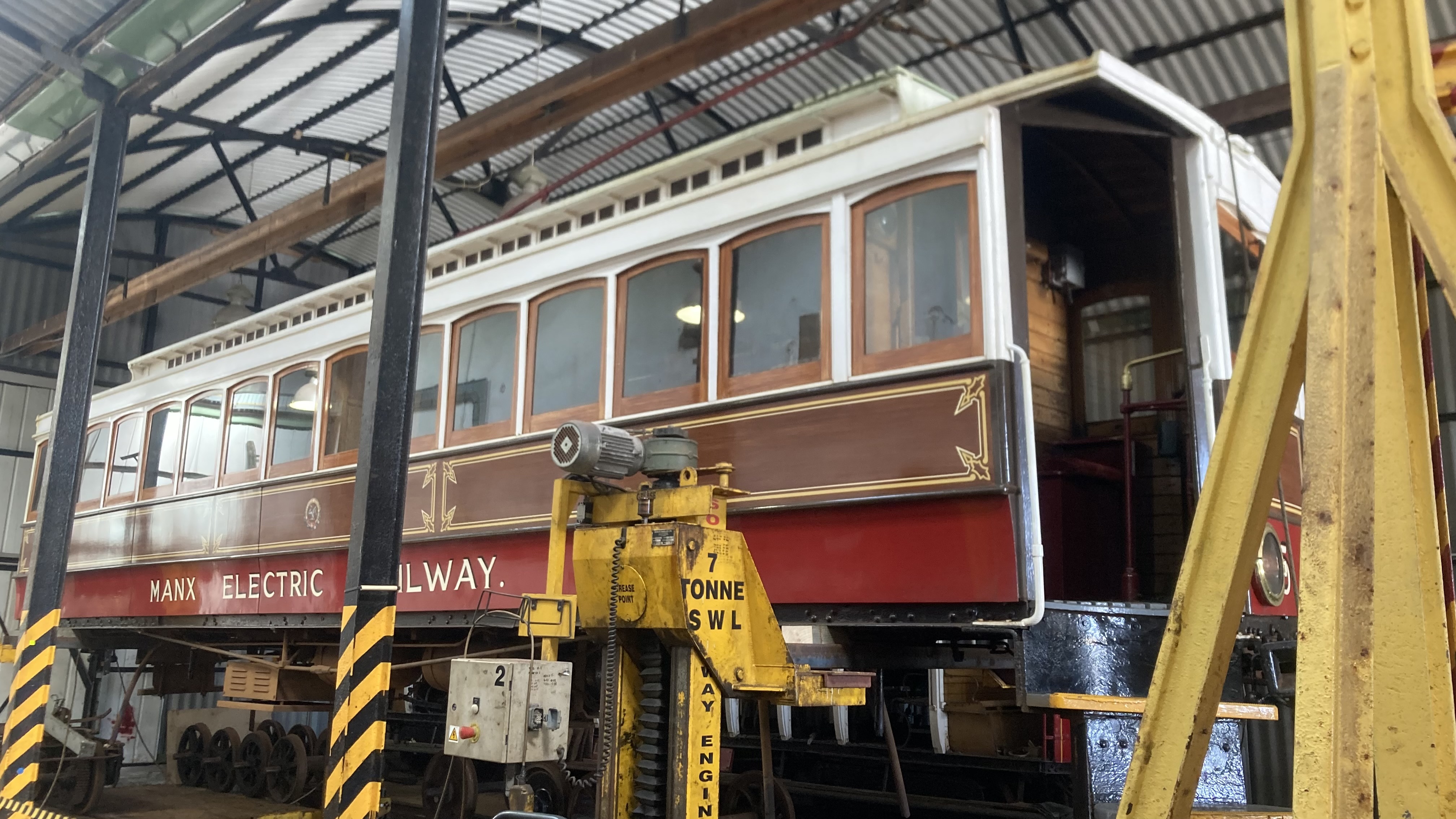
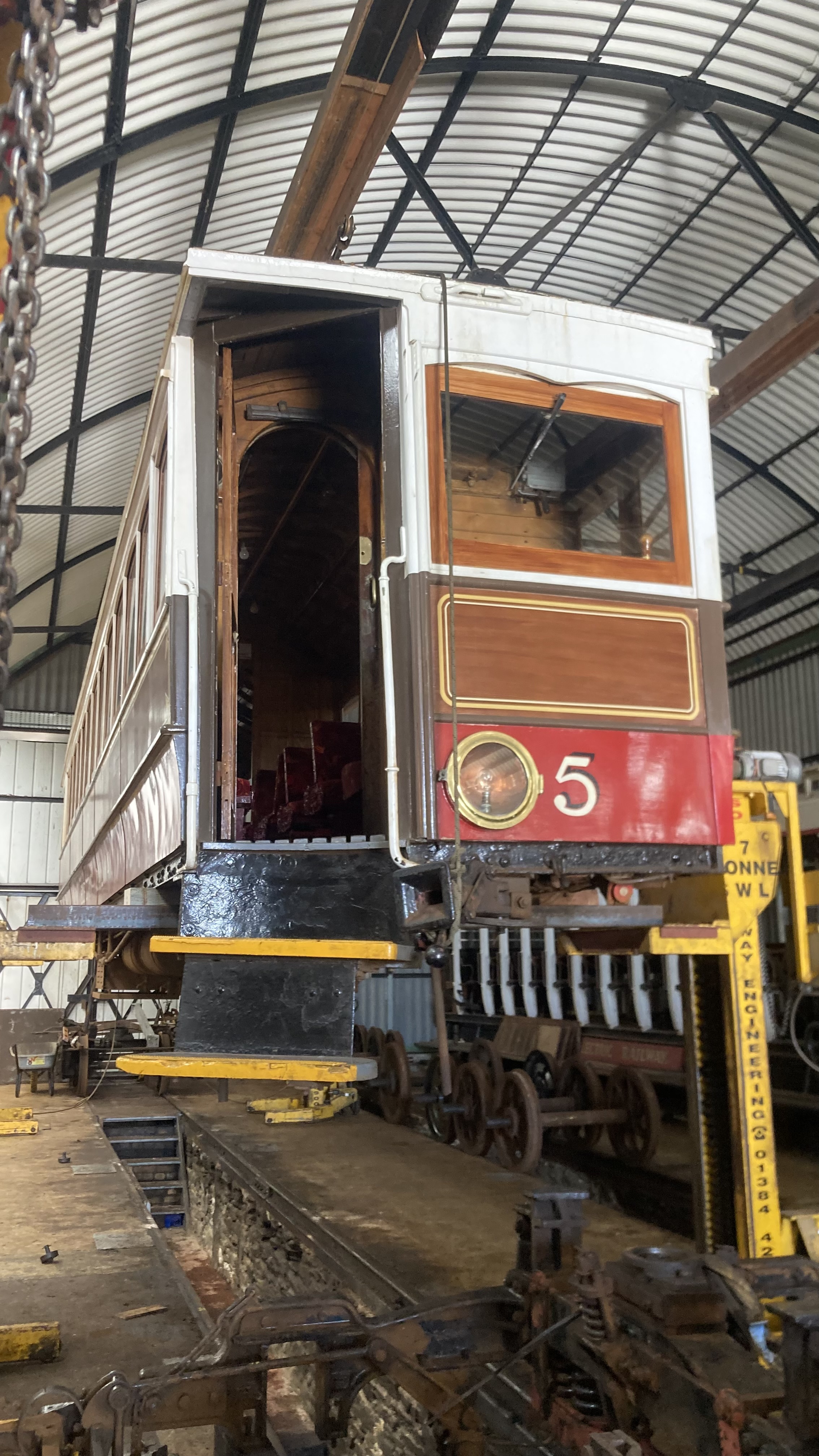
 During the guided tour of the Manx Electric Railway’s Derby Castle Sheds and Workshops, organised by Manx National Heritage on Sunday 11 October, Car No. 5 was observed undergoing a significant overhaul.
MTR No. 103 has previously reported: “Repairs were undertaken to the Douglas end seaside corner pillar of Car 5, where minor decay had been identified; this had extended to the main front window sash. The design of the wooden covering on the pillar was modified to prevent further water ingress. A new window was fitted in the motorman’s cab. The white paintwork on the upper half of the vehicle around the windows was repainted.”
Until relatively recently, major overhauls—such as those requiring access to the trucks and motors—were made more difficult by the continued use of antiquated bottle jacks. This method involved raising the car body incrementally and supporting it on wooden blocks before further elevation.
For many years, the MER Society advocated in its journals, meetings and reports for the adoption of car jacks, as had been used by tram systems and others for years. Thankfully, since the acquisition of proper electric lifting gear, looking after the Island's trams has become significantly less difficult.
The jacks are just one of numerous welcome innovations adopted by the Island’s railways—both within the workshops and, perhaps more notably, by permanent way gangs engaged in track relaying (where the latest technology is now employed)—Car No. 5 is shown in the lower No. 1 Car Shed at Derby Castle. It has been elevated using a set of four Hathaway Engineering 7-tonne jacks to facilitate the removal of its trucks.
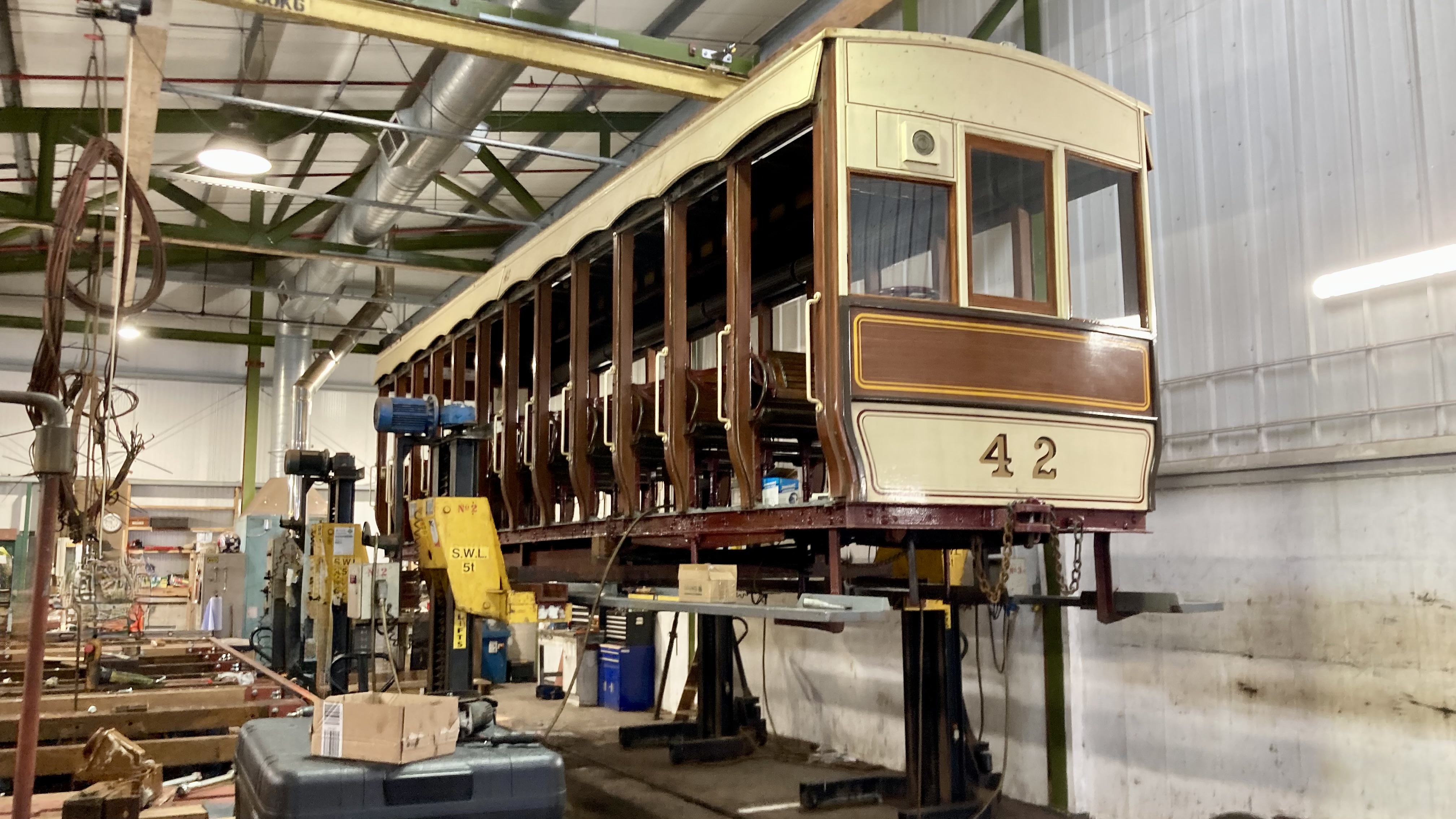
Meanwhile, in the Top Car Shed, Trailer 42 was seen resting on a quartet of Walter Somers Ltd 5-tonne lifts. This vehicle, constructed in 1903, was relocated to Laxey Car Shed in early October 2025 to facilitate the temporary transfer of its trucks and braking equipment to Works Trailer 52. The trucks and braking gear of the latter are currently undergoing refurbishment. Trailers 43 and 52 (and 42) are distinctive in being mounted on former motor car Milnes plate frame trucks. The trucks will be reinstated to Trailer 43 upon completion of the refurbishment of those on Trailer 52. This temporary arrangement will ensure that Works Trailer 52 remains operational throughout the winter period.
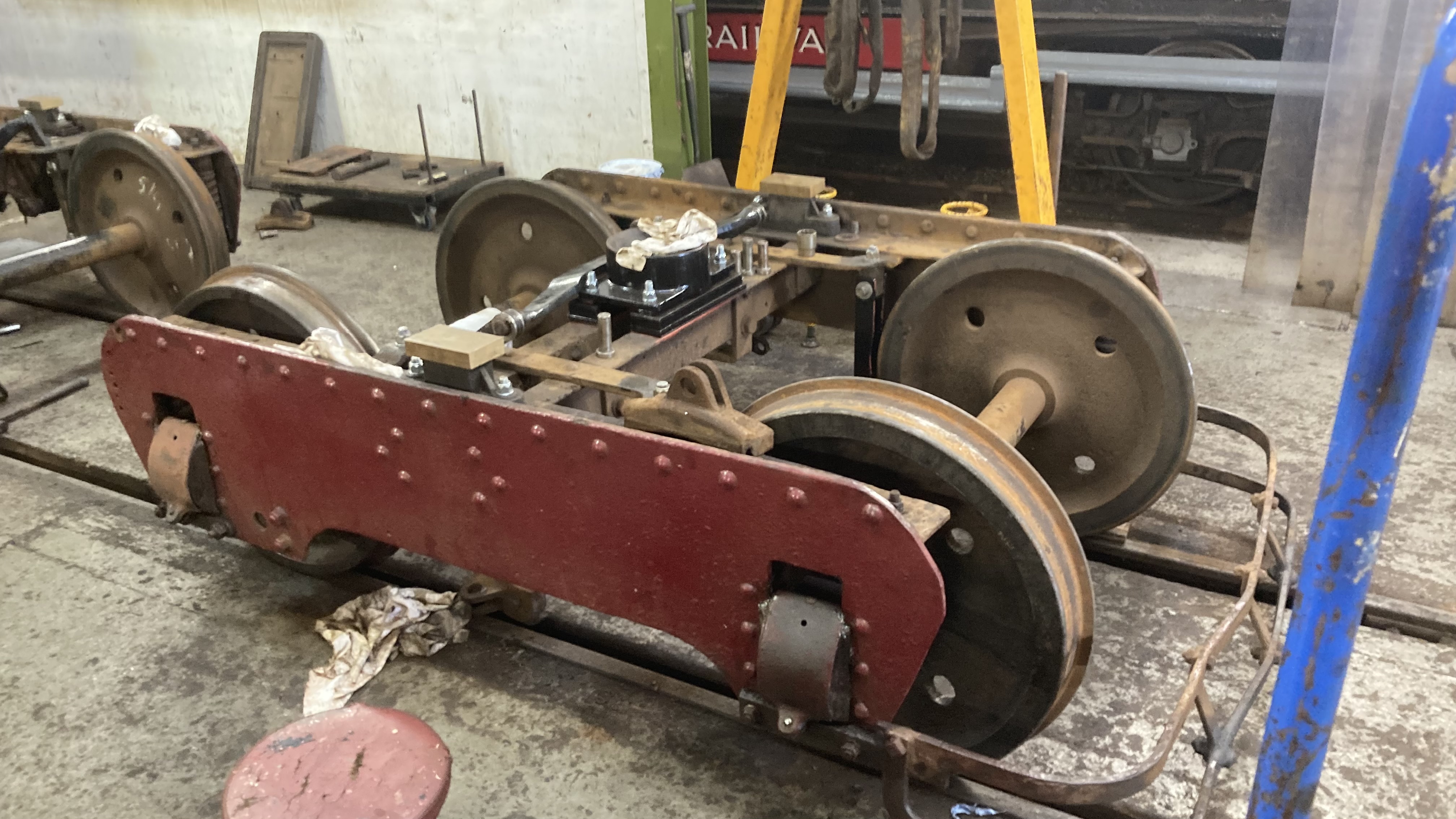
ABOVE: Former motor car Milnes plate frame trucks are easily identifiable by their much deeper side frames. This one from Trailer No.42 is undergoing overhaul, Derby Castle Top Shed, October 11th 2026.

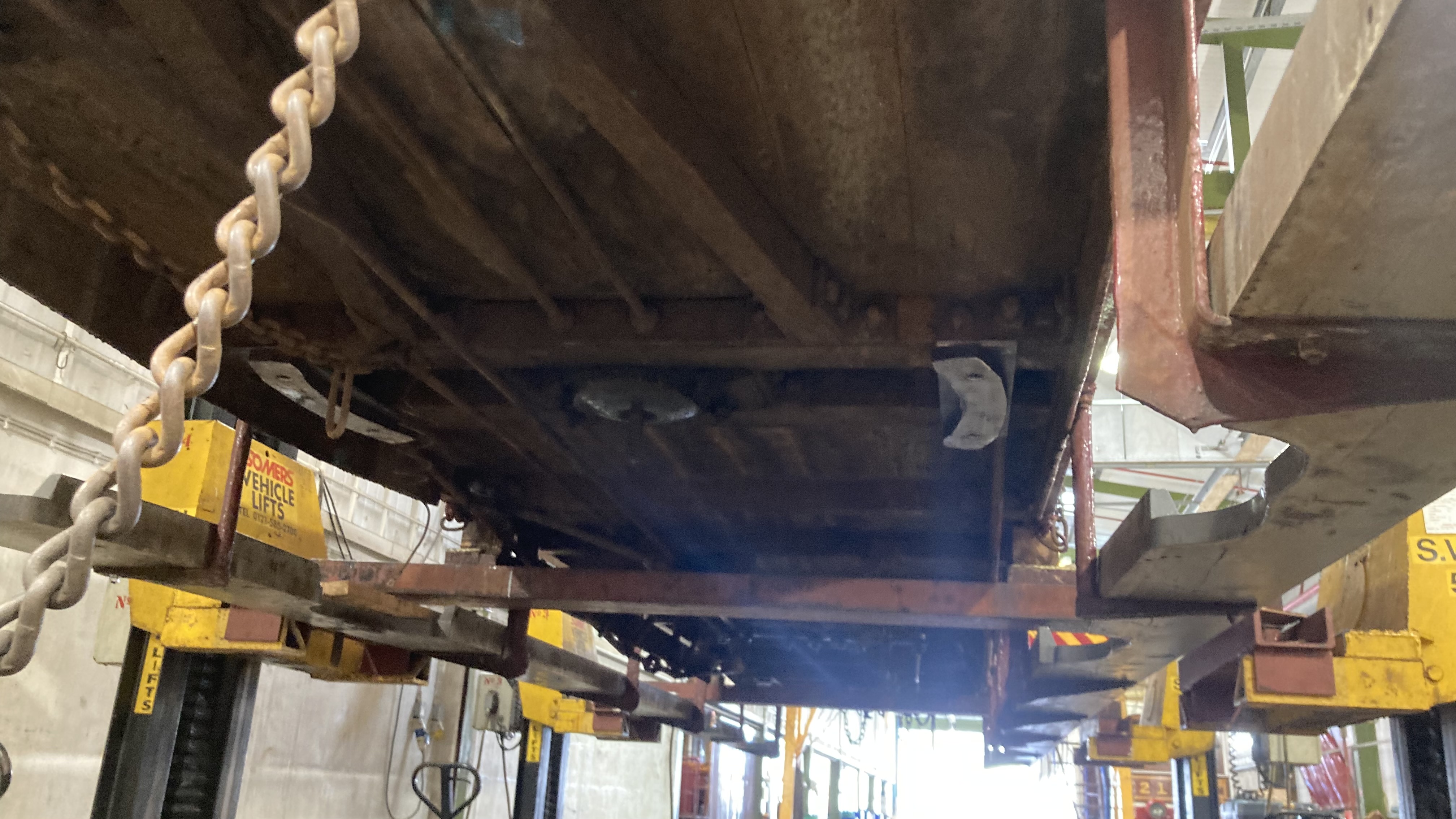
ABOVE: Underneath Trailer 42, clearly showing the pair of semi-circular pads on which the truck cross member or transom rests. As described below, there is only one stage of suspension on these trucks, that provided by the coil springs either side of each axle box (see below).
The MER Society's late Chairman Mike Goodwyn, writing in the Society publication All About the Manx Electric Railway, had this to say about the Milnes trucks:
The trucks supplied by G F Milnes to the MER were broadly existing designs modified as necessary to incorporate electric traction motors, the trailer car trucks are virtually identical to antique designs for cable cars and steam tram trailers. The MER's Milnes trucks can be divided into three sub-types as there are some detail differences.The first group (Series 1) represent the 1893 and 1894 trailer car trucks, which are outwardly identifiable by the five rivets fastening the transoms to the sideframes.These are presently fitted to Trailer Cars Nos. 40, 41, 44, 46, 47, 48, 49,50 and 51 (now renumbered 13), Nos. 53, 54 and 60. The second series (S.2) are similar in outward appearance but have only four snap-head rivets at the centre of the sideframes. This type is fitted to Trailers Nos. 36, 37, 45, 46, 47, 48 and 59. The trucks of the first and second series are regarded as interchangeable.
The third series (S.3) is the powered truck design which first made its appearance in 1893 under Cars Nos. 1-3. The design was subject to some detail revision as time went on, and trucks of this group are fitted to Cars Nos. 14, 15, 17 and 18 of 1898, and under Cars Nos. 28-31 of 1899. All are fitted with axle-hung nose-suspended 20-horsepower traction motors supplied by the Electric Construction Company of Wolverhampton, and driving through open spur gearing. The trucks fitted to the two groups of cars may also be regarded as interchangeable. Between 1900 and 1914 Car No. 17's trucks were usually in use underneath the Loco (No.23) each winter. The re-equipment programme of 1902-4 replaced a number of Milnes trucks with new Brush trucks, and some spare Milnes trucks of the third series, but without their motors, are fitted to Trailer Cars Nos. 42 and 43, and are readily identifiable by their much deeper side frames.
Overall the Milnes trucks are relatively crude and incorporate only one stage of suspension. Even this is somewhat limited in its deflection under load, presumably because of the absence of a traction motor nose suspension that would allow the the motor to follow the relative rise and fall of the wheelset when running. The truck frames were built up from ordinary structural steel sections and plate, and are extremely simple. For their weight they have great strength, but feature no separate bolster at all. This in turn has a considerable effect on the carbodies when running, as the superelevation of the track at curves is instantly transmitted to the carbody, which is racked and twisted to suit the contour of the track. Since the cars to which these trucks are fitted run for at most a few weeks of each year (and in some cases not at all), the process may be capable of being indefinitely extended.