“Douglas Council says it's 'disappointed' that the horse trams are not operating along the full length of the promenade, and it's not the only issue causing ire in the local authority.
Regarding the horse trams, despite Tynwald approving funding back in 2017 to reinstate the full route from Derby Castle to the Sea Terminal, the service currently runs only as far as Broadway.
The council says: ‘First introduced in 1876, the horse tram service is widely recognised as the last surviving original horse-drawn tramway of its kind anywhere in the world.’
‘Together with the Manx Electric Railway and the Isle of Man Steam Railway, it forms a central part of the Island’s unique Victorian transport heritage and plays a vital role in supporting tourism and cultural identity.’
The local authority says the full reinstatement is both a 'symbolic and practical priority' in what is the tramway's 150th year.
It argues that having the service run along the entire promenade would strengthen Douglas’s appeal as a visitor destination and 'safeguard a globally significant piece of living heritage for future generations'.
Douglas Council stopped running the horse tram service in 2016, claiming it was no longer financially viable.
The Department of Infrastructure subsequently took over operations saying the purchase formed part of plans to ‘retain the island's heritage infrastructure’.
Now, Douglas Council wants Tynwald to reaffirm its 2017 commitment and deliver the long-promised completion of the scheme without further delay.
Back in March, the Department of Infrastructure was tasked with returning to Tynwald with a business case for the full line.
The business case has missed the deadline for inclusion on the order paper.
Subsequently, it will not appear on May's 'main' order paper.
The only way for it to be debated this month will be if special permission is sought from the President of Tynwald, who may request the creation of a supplementary order paper.
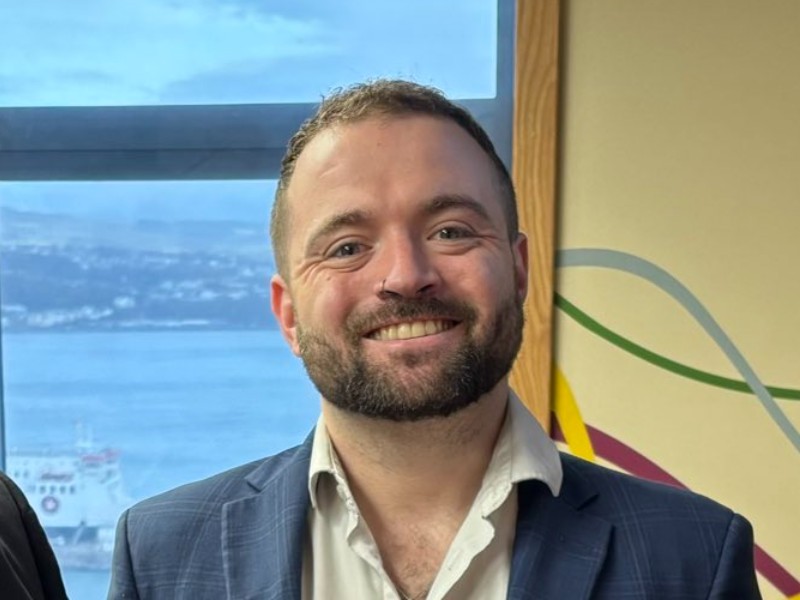
Meanwhile, the leader of Douglas Council has told Manx Radio that the issue with the so-called ‘Halfway Horse Tram’ is indicative of a wider issue affecting the promenade.
Devon Watson told Manx Radio that a ‘mismatch of governance’ is leading to parts of the coastal route appearing ‘dilapidated and broken down’.
Following recent storm damage to the Sunken Gardens, the Chair of the council's Regeneration Committee, Natalie Byron-Teare, argued the Department of Infrastructure's sea wall should be extended to that end of the promenade which she says is 'most affected' by coastal overtopping and high tides.
Mr Watson echoes these remarks, saying the 'incomplete' sea wall is having an impact on both private and public sector investment in the promenade itself.”
Mr Watson’s comments can be heard HERE
"DEVON WATSON: We have the oldest horse tram network in the world. And actually this year they turn 150 years old in August. Heritage is absolutely critical for tourism, and ultimately downstream from that is is the hospitality industry, which is struggling. So heritage is not only something that's useful from an economic perspective, it also roots us in place. What we see is a Douglas that is changing, that is modernizing, that's adapting. We see new buildings going up, and it's really important that we have that heritage aspect to root us in place and connect us back to our parents and our grandparents and our great grandparents and the people who helped build this island.
Tynwald has voted to preserve and extend that route. This has been an ongoing battle, and it's really important that we actually finish this work and get it done, rather than just having half a network or half a heritage system. It feels as though when it comes down to the prom, what we've done is collectively feels like government has declared victory before the fight has actually been won or is over. And what we see when we look at the problem is we see a mismatch of governance. We see railings that are dilapidated and broken down.
We see a patchy walkway, we see incomplete sea defences, which also means that both private and public sector entities like the local authority, cannot really invest in improving the problem until those sea defences are complete and this delays critical, needed investment in our capital. And just this is the gateway to the Island and we just need to get all of this work complete so we can really start focusing on improving the lived lives of people here on the Isle of Man.
CHANELLE SUKHOO: Now, in terms of the Horse Tram, the motion, I know the DoI is due to put a motion to on the register of business that will appear in the May sitting of Tynwald. But they haven't done that yet. And today is actually that two week mark to get that motion in, in order for it to go through that, that, that, that sitting. I checked about ten minutes ago. I haven't seen it there. Maybe it'll be updated later. I'm not sure. But as as of now, it's not there.
What goes through your mind when you hear that?
DEVON WATSON: I think it's disappointing because what we want to see is we want to see this work done. We want to start investing in the capital. We want to start investing in building those playground facilities on the prom. And until those horse trams are complete and until those sea defences are complete, it becomes very difficult to have the certainty required to put millions of pounds into a major investment like that. And this goes same for the private sector as it does for the public sector. I think the most important thing to think about heritage. Heritage isn't just a thing that is a cost, or it can't be judged purely on the economics of it.
Heritage is something that we inherit from the people that have created our built environment, and it's something we steward for future generations. So it's something that we really have to invest in, and it's something that we have to take seriously. I think it's important that we have the oldest horse tram network in the world, and it's something that makes us unique. It's something that makes us special. And I know that the horse trams are like Marmite. The last thing that people want to do is focus on that. But I think what we need to do is we need to embrace heritage as a part of our lived experience, and that will hopefully, help build not only that cultural identity in the island, but also build the impetus for a revived tourism sector.
CHANELLE SUKHOO: And I think, Devon, my last question would be, you know, you represent Douglas City Council, which represents the people of Douglas. And like you said, you know, the the horse trams, it's like Marmite. Some people are for them, some are a aren't for them. But you know when you. When? When you know you know that the Doi should be doing this. Or last week when the infrastructure minister said, you know, they haven't had a chance to put this through yet representing the people that you represent. What would be your message, maybe to the Doi or to the Doi Minister?
DEVON WATSON: I think the one thing that I want to sort of confer forward, and not only to DoI I've had great chats with the DoI, but also to Treasury and to the world as a whole, is that no country has ever regretted, um, investing too much in infrastructure. No country has ever said, oh, our infrastructure is too good. Our public facilities are too good, the public realm is too good, or our tourism sector is too good. Right? So I think at the end of the day, we need to view this as a sort of long term investment and really think about what the Island could become, because I know that we focused heavily or we should be focused on the cost of living.
But at the same time, that shouldn't mean that we leave parts of the Island's cultural identity fall by the wayside, and these things are always going to be controversial. Any major investment is going to be controversial. But then the day being in public service means you have to be brave."